Timur and the Timurid Renaissance
A conqueror who built a capital and a dynasty that turned it into one of the great cultural moments in history. Here is the story of Timur and the Timurid renaissance that gave Samarkand its monuments.
Almost everything a visitor admires in Samarkand traces back to one man and his descendants. Timur — known in the West as Tamerlane — was a 14th-century conqueror who made Samarkand his imperial capital and drew the finest builders, artists and scholars of the age into it. The dynasty he founded, the Timurids, then turned that concentration of talent into a genuine renaissance.
It is a story with two faces. Timur's empire was built through campaigns of extraordinary brutality across Persia, India and the Caucasus. Yet the same wealth and the same captured craftsmen produced the blue domes, the Registan's first madrasa and an astronomical observatory ahead of its time. To understand Samarkand — the heart of our destination of that name — you have to hold both halves of the Timurid story at once.
Who Timur was
Timur was born around 1336 near Shahrisabz, south of Samarkand, into a Turkic-Mongol clan. He was not a descendant of Genghis Khan and so could never take the title of khan himself; he ruled instead as an emir, governing through puppet khans while holding the real power. A leg injury early in life gave him the name Timur the Lame, rendered in Europe as Tamerlane.
From the 1370s until his death in 1405 he campaigned almost without pause, assembling an empire that reached from Anatolia and Syria to the edge of India. He died at nearly seventy on the march east toward China, a campaign he never began. He was buried in Samarkand, in the Gur-i-Amir, the tomb that became the dynasty's mausoleum.
Samarkand as an imperial capital
Timur chose Samarkand as his capital and set out to make it the most magnificent city on earth. His method was characteristic: when he conquered a city, he deported its most skilled craftsmen — masons, tilemakers, weavers, metalworkers — back to Samarkand to work on his projects. Builders from Persia, Azerbaijan, India and Syria all left their hands on the city.
He also indulged a conqueror's sense of scale and a conqueror's humour, ringing Samarkand with satellite villages he named after the great cities he had taken — a Cairo, a Baghdad, a Damascus — so that the real capitals seemed mere suburbs of his own. The Bibi-Khanym Mosque, raised in the 1390s as one of the largest mosques in the Islamic world, embodied the ambition; it was built so fast and so large that parts began to fail almost at once.
Ulugh Beg, the astronomer-king
The renaissance deepened under Timur's grandson, Ulugh Beg, who governed Samarkand from 1409 and was a scholar far more than a soldier. He built the madrasa that still stands on the Registan and gathered mathematicians and astronomers around it, making the city a centre of learning rather than only of conquest.
His greatest project was an observatory, built in the 1420s on a hill at the edge of Samarkand. Its central instrument was an enormous arc, a sextant of around 40 metres radius set into the bedrock, with which his team measured the length of the year and the positions of more than a thousand stars with an accuracy unmatched for centuries. The star catalogue produced there, the Zij-i-Sultani, was studied across the Islamic world and later in Europe. Ulugh Beg was murdered in 1449, and the observatory was destroyed; its underground arc was rediscovered only in 1908 and can be visited today.
The Timurid style
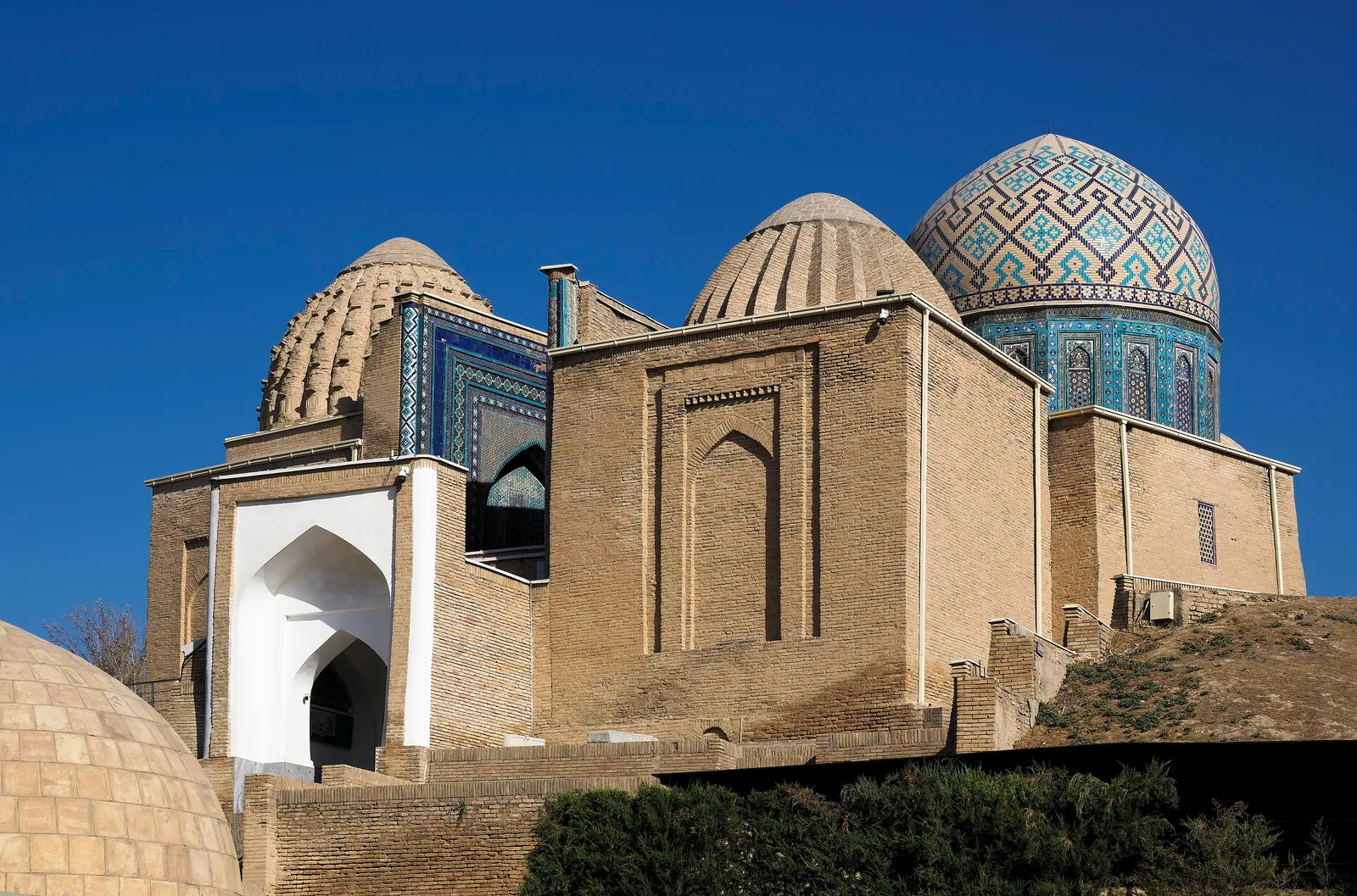
The Timurids gave Central Asia a recognisable architectural language: monumental scale, the towering portal flanked by minarets, and above all the high, ribbed, melon-shaped dome sheathed in turquoise and cobalt tile. The bulbous double dome — an outer shell raised dramatically above an inner ceiling — is a Timurid signature, and the colour gave Samarkand its lasting nickname, the blue city.
The renaissance was not only architectural. Timurid Herat, in present-day Afghanistan, became a famous centre of Persian miniature painting, calligraphy and poetry; the manuscript arts flourished as richly as the building arts. This is the cultural world a traveller crosses into on The Silk Road Reborn — and the descendant who carried its style furthest was Babur, a Timurid prince who lost Central Asia, conquered India, and founded the Mughal Empire there.
Where to meet the Timurids in Samarkand
Three sites tell the Timurid story most directly. The Gur-i-Amir holds Timur's tomb beneath a fluted azure dome and a famous slab of dark jade; it is the dynastic mausoleum and the obvious place to begin. The Shah-i-Zinda, a steep lane of tombs, includes many graves of Timur's family and court and shows Timurid tilework at its most intense and varied.
The third is the Ulugh Beg Observatory on its hillside, where the surviving arc makes the dynasty's scientific ambition tangible in a way no facade can. Seen together, these three places turn the Timurid renaissance from a label into something you have walked through — which is exactly how our Samarkand itinerary is ordered.
Quick answers
Who was Timur, and is he the same as Tamerlane?
Yes — Timur and Tamerlane are the same person. He was a 14th-century Turkic-Mongol conqueror, born around 1336 near Shahrisabz, who built an empire stretching from Anatolia to the edge of India and made Samarkand his capital. Tamerlane is the European rendering of Timur the Lame, a nickname from a leg injury he carried through life.
What was the Timurid renaissance?
It was a flourishing of architecture, science, painting and literature across Central Asia under Timur and his descendants in the late 14th and 15th centuries. It gave Samarkand its blue-domed monuments, produced the advanced astronomy of Ulugh Beg's observatory, and made Timurid Herat a famous centre of Persian miniature painting and poetry.
Why was Ulugh Beg important?
Ulugh Beg, Timur's grandson, ruled Samarkand from 1409 and was a serious astronomer and mathematician. He founded the madrasa on the Registan and built an observatory whose huge stone arc allowed his team to measure the year's length and catalogue over a thousand stars with accuracy unmatched for centuries. He was murdered in 1449.
Let the reading become a route.
When an article sparks something, our planners are the next step. Tell us what you are dreaming of.