Travelling Uzbekistan Today: A Practical Primer
The Silk Road cities are far easier to reach than most travellers expect. A practical primer on getting around Uzbekistan today — the fast trains, the visa rules, when to go, and how the three oasis cities link up.
Uzbekistan has quietly become one of the most straightforward countries in Central Asia to travel. Visa rules have been sharply liberalised since 2018, a fast-train network now connects the main Silk Road cities, and tourism infrastructure has grown quickly. The romance of Samarkand and Bukhara no longer comes with the friction it once did.
This primer covers the practical questions a first-time visitor actually asks — visas, the best season, money, the rail network and how the three oasis cities string together. It is the groundwork behind our Silk Road Reborn journey, and it explains why Uzbekistan is the comfortable centrepiece of the longer Long Way East.
Visas and entry
Uzbekistan reformed its visa regime substantially from 2018 onward, and entry is now simple for many travellers. Citizens of a long list of countries — including the United Kingdom, the European Union states, Japan and others — may enter visa-free for stays of up to 30 days. Many other nationalities, including United States citizens, can apply for an inexpensive e-visa online before travel.
Rules do change, so always confirm the current requirement for your own passport before you book flights. The old Soviet-era practice of registering with authorities for each night of your stay still technically exists, but in practice hotels handle the registration for you automatically — keep the small slips they issue until you leave the country.
When to go
Uzbekistan has a sharply continental climate: hot, dry summers and cold winters, with the desert around Khiva at the extremes of both. The two shoulder seasons are decisively the best time to travel. Spring, roughly April into early June, brings mild days and green landscapes; autumn, September into October, brings warm, settled weather and the melon and grape harvest.
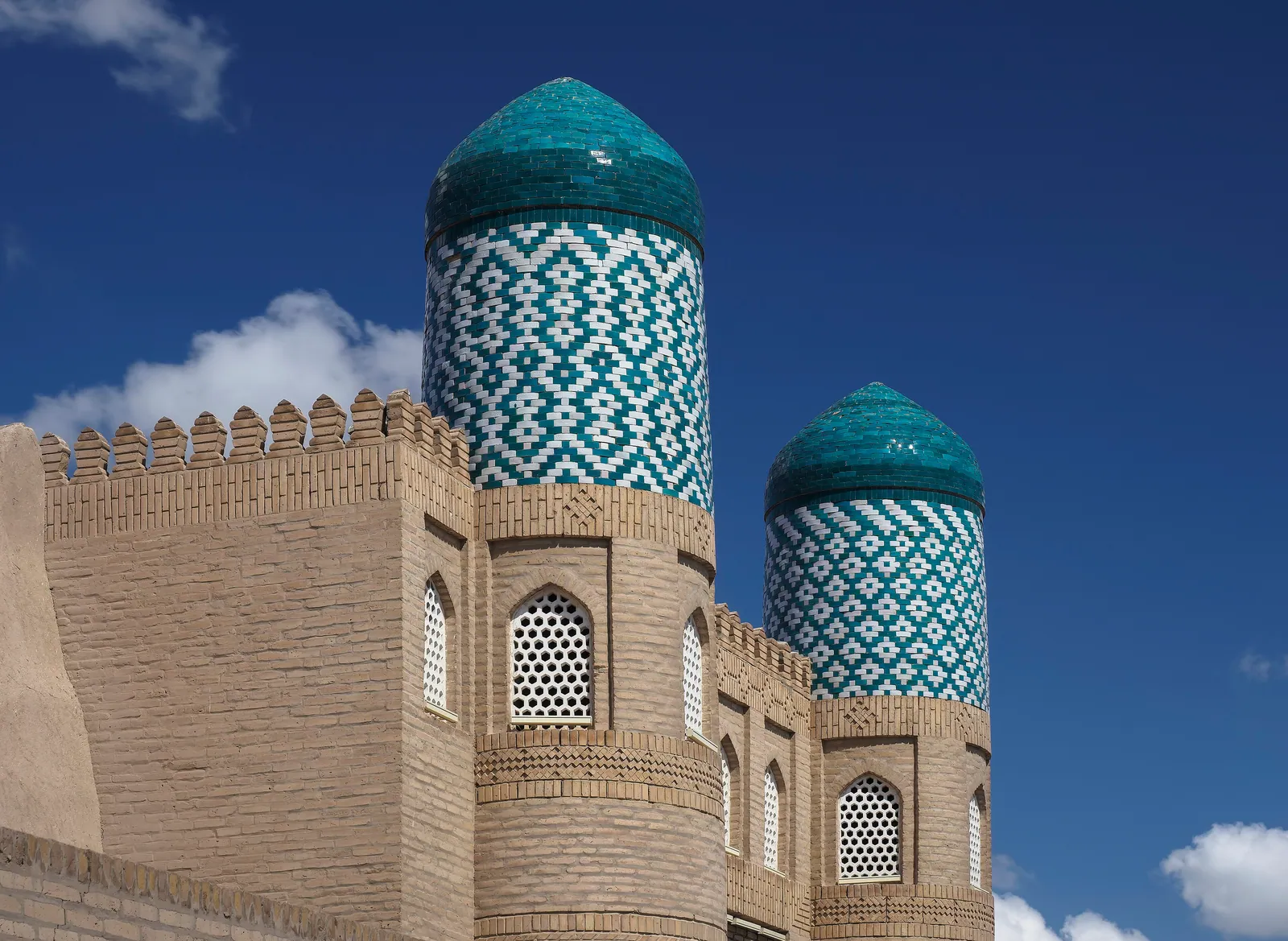
High summer, July and August, can push past 40 degrees Celsius and makes daytime sightseeing genuinely punishing, particularly in Khiva and Bukhara. Winter is cold and quiet but has its own austere appeal, with the blue domes occasionally under snow. Our Silk Road departures are timed to the shoulder seasons for exactly these reasons.
The fast trains between the cities
The single best thing about travelling Uzbekistan today is the railway. The high-speed Afrosiyob train links Tashkent, Samarkand and Bukhara at speeds up to 250 kilometres per hour: Tashkent to Samarkand takes a little over two hours, and Samarkand on to Bukhara about another hour and a half. The trains are modern, air-conditioned, comfortable and reliable, and they make the classic triangle of cities effortless.
Khiva is the exception, lying far to the west across the desert. It is now reachable by direct train from Tashkent and Bukhara, though the Bukhara-Khiva run is a long daytime journey of several hours across the Kyzylkum. The alternative is a short domestic flight into nearby Urgench. Either way, popular trains sell out in high season, so seats are best secured well ahead — something a planned journey handles for you.
Money, connectivity and language
The currency is the Uzbek som. For years it traded in such large denominations that travellers carried bricks of cash, but ATMs are now widespread in cities and card payment is increasingly accepted in hotels, larger restaurants and shops. Carry some cash for bazaars, taxis and smaller towns; US dollars are the easiest currency to exchange and should be clean and unmarked.
Mobile data is cheap and a local SIM is easy to buy with your passport. Uzbek is the official language and written in a Latin-based alphabet; Russian remains widely understood, especially among older people and in Tashkent. English is growing among younger Uzbeks and in tourism, but it is far from universal — a few words of Uzbek or Russian, and a guide, both go a long way.
How the three cities link up
The natural route runs roughly east to west and lets the cities build on one another. Most journeys begin in Tashkent, the modern capital, then take the fast train to Samarkand for its monumental set pieces — the Registan, the Gur-i-Amir, the Shah-i-Zinda. From Samarkand the train continues to Bukhara, a quieter, more intimate medieval old town to be walked rather than ticked off.
Khiva, far to the west, comes last: the smallest, most concentrated and most remote of the three, its walled Itchan Kala a fitting climax at the desert's edge. Many itineraries also fold in Shahrisabz, Timur's birthplace, or the Ferghana Valley for its ceramics and silk. Allowing a night in each main city, rather than rushing, is the difference between seeing the Silk Road and feeling it — and slow, unhurried pacing is the principle our journeys are built on.
Quick answers
Do I need a visa to visit Uzbekistan?
It depends on your nationality. Since visa reforms from 2018, citizens of many countries — including the UK, EU states and Japan — can enter visa-free for up to 30 days, while others, including US citizens, can apply for an inexpensive e-visa online. Rules change, so always confirm the current requirement for your passport before booking travel.
What is the best time of year to visit the Silk Road cities?
The shoulder seasons are best: spring, from April into early June, and autumn, from September into October, both offer mild, settled weather. High summer can exceed 40 degrees Celsius and makes sightseeing in Khiva and Bukhara very hard. Winter is cold and quiet but atmospheric, with the blue domes sometimes under snow.
How do you travel between Samarkand, Bukhara and Khiva?
Tashkent, Samarkand and Bukhara are linked by the high-speed Afrosiyob train, fast and comfortable, putting Samarkand about two hours from Tashkent and Bukhara around ninety minutes beyond that. Khiva, far west across the desert, is reached by a longer direct train or by a short flight into nearby Urgench. Popular trains sell out in high season.
Let the reading become a route.
When an article sparks something, our planners are the next step. Tell us what you are dreaming of.