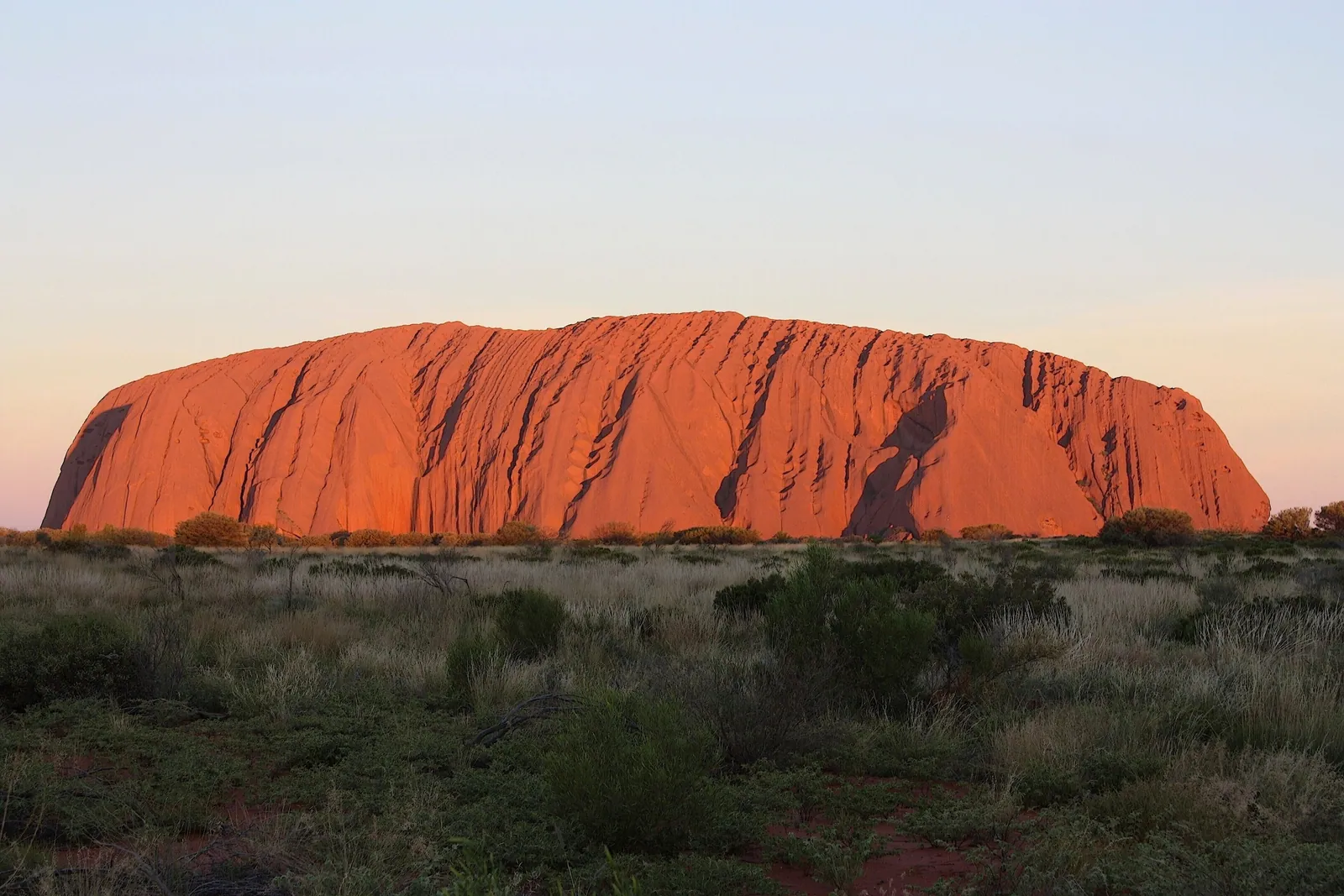
Uluru and the Red Centre: Reading the Heart of Australia
Uluru is the most recognisable landform in Australia and far older than the desert around it. Here is how the great rock was formed, what surrounds it, and how to experience the Red Centre well.
Uluru is a single, vast block of sandstone rising 348 metres from the flat scrub of central Australia, roughly in the geographic heart of the continent. It sits within Uluru-Kata Tjuta National Park, a UNESCO World Heritage Site recognised for both its natural drama and its profound living cultural significance to the Anangu, the Aboriginal people who are its traditional owners.
The shorthand answer for any traveller is that the Red Centre rewards slowness and respect. Uluru is best experienced not by climbing or conquering it — climbing was permanently closed in 2019 at the long-standing request of the Anangu — but by walking its base, watching it change colour through the day, and understanding it as a place that has been continuously cared for and storied for tens of thousands of years.
What Uluru is, geologically
Uluru is an inselberg — an isolated rock that stands abruptly above a plain — composed of arkose, a coarse sandstone rich in feldspar. It formed from sediment laid down some 500 million years ago, later tilted almost vertical by enormous earth movements, so the rock layers you see now run nearly upright rather than flat. What is visible above ground is only the tip; the formation continues for several kilometres beneath the surface.
Its famous rust-red surface is a thin skin. The arkose is naturally grey; iron minerals within it have oxidised at the exposed surface, in effect rusting, to give the rock its colour. Where flakes have spalled away, the fresher grey rock beneath is visible. The same iron-rich weathering is responsible for the deep red of the surrounding sand.
The light, and why colour is the point
Uluru appears to change colour through the day, and this is not an illusion of mood. Its hue depends on the angle and quality of sunlight striking the iron-stained surface. At sunrise and sunset, when light travels a longer path through the atmosphere and shorter blue wavelengths scatter away, the rock can glow an intense ember red before fading to mauve, ochre and grey.
Rain transforms it again — a rare desert downpour turns Uluru silver-grey and sends temporary waterfalls down its flanks into the waterholes at its base. The national park maintains dedicated sunrise and sunset viewing areas precisely because watching this slow shift, ideally across more than one day, is the central Uluru experience.
Walking the base
The finest way to know Uluru is the Uluru Base Walk, a roughly 10-kilometre loop on flat ground that circles the entire rock. Up close, the monolith dissolves into detail: caves, ribs, plunge-pools, ancient rock art, waterholes fringed with greenery, and sheer walls fluted by the wind. Sections of the walk are designated as sensitive sites where photography is asked to be avoided, out of respect for their significance to the Anangu.
Shorter marked walks — the Mala Walk and the walk to the Kuniya waterhole at Mutitjulu — cover the most rewarding stretches for those who prefer not to do the full circuit. Whichever you choose, an early start is wise: by mid-morning in the warmer months the heat is severe, and the park advises walking before the day grows hot.
Kata Tjuta, the other great formation
Forty kilometres west of Uluru, and part of the same national park, stands Kata Tjuta — a cluster of 36 steep-sided domes whose name means 'many heads' in the Pitjantjatjara language. They are geologically distinct from Uluru, made of conglomerate, a rock of cemented pebbles and boulders, and the tallest dome rises higher than Uluru itself.
Two walks explore them: the short, sheltered Walpa Gorge walk between two of the largest domes, and the longer Valley of the Winds circuit, which threads through the heart of the formation. Like Uluru, Kata Tjuta is a deeply significant place for the Anangu, and parts of it are associated with knowledge that is not publicly shared.
Practicalities of the Red Centre
Almost all visitors stay at Yulara, the resort township just outside the park boundary, which is the only accommodation base in the area and a short drive from both Uluru and Kata Tjuta. The park itself requires an entry pass, valid for several days, with proceeds shared with the Anangu traditional owners. There is no town inside the park.
The kindest seasons are the southern autumn, winter and spring — roughly April to September — when days are clear and warm and nights can be genuinely cold. The summer months bring fierce heat, with daytime temperatures regularly above 40 degrees Celsius, and walks are restricted in the hottest part of the day. On The Pacific Arc journey we time the Red Centre for the cooler half of the year and structure days around dawn and dusk, both for comfort and because that is when the desert is at its most beautiful.
Quick answers
Can you climb Uluru?
No. Climbing Uluru was permanently closed on 26 October 2019, fulfilling a long-held wish of the Anangu traditional owners, for whom the rock is a sacred place and the climb route a culturally significant path. The closure is widely respected, and the base walk and surrounding trails offer a far richer and more appropriate way to experience Uluru.
How long should I spend at Uluru and Kata Tjuta?
Two to three full days allows an unhurried experience: a base walk at Uluru, the sunrise and sunset viewings, and at least one of the Kata Tjuta walks, ideally the Valley of the Winds. A single day is possible but rushed, and it tends to miss the slow shift of light that is the heart of the place.
When is the best time of year to visit the Red Centre?
The southern autumn to spring, roughly April to September, offers the most comfortable conditions: warm, clear days and cold nights. The summer months from December to February bring extreme heat, often above 40 degrees Celsius, when longer walks are closed during the hottest hours. Whenever you visit, carry far more water than feels necessary.
Let the reading become a route.
When an article sparks something, our planners are the next step. Tell us what you are dreaming of.