Under the Clearest Sky: Stargazing and the Great Atacama Observatories
The Atacama has the darkest, driest, steadiest skies on Earth — which is why the world built its telescopes here. What makes the desert sky so good, and how a traveller can spend a night beneath it.
The Atacama Desert has, by broad agreement, some of the finest night skies on the planet — and the proof is institutional. The world's astronomers do not build billion-dollar observatories on a hunch; they build them where the sky is measurably the best, and a remarkable share of the great telescopes of the Southern Hemisphere now stand in this one Chilean desert.
For a traveller, that has a simple and happy consequence. The same conditions that draw the astronomers — dry, dark, high, steady air — turn an ordinary guided evening with a telescope into one of the most memorable hours of an Atacama week. Here is why the desert sky is so extraordinary, and how to spend a night under it.
Why the Atacama sky is the best on Earth
Four things make a sky good for astronomy, and the Atacama has all four at once. It is exceptionally dry — the driest non-polar desert on Earth — so there is almost no water vapour to blur or absorb the light. It is high, with observatory sites well above 2,400 metres and some above 5,000, lifting the telescopes above much of the atmosphere. It is far from cities, so light pollution is minimal. And its air is unusually steady, which astronomers call good seeing.
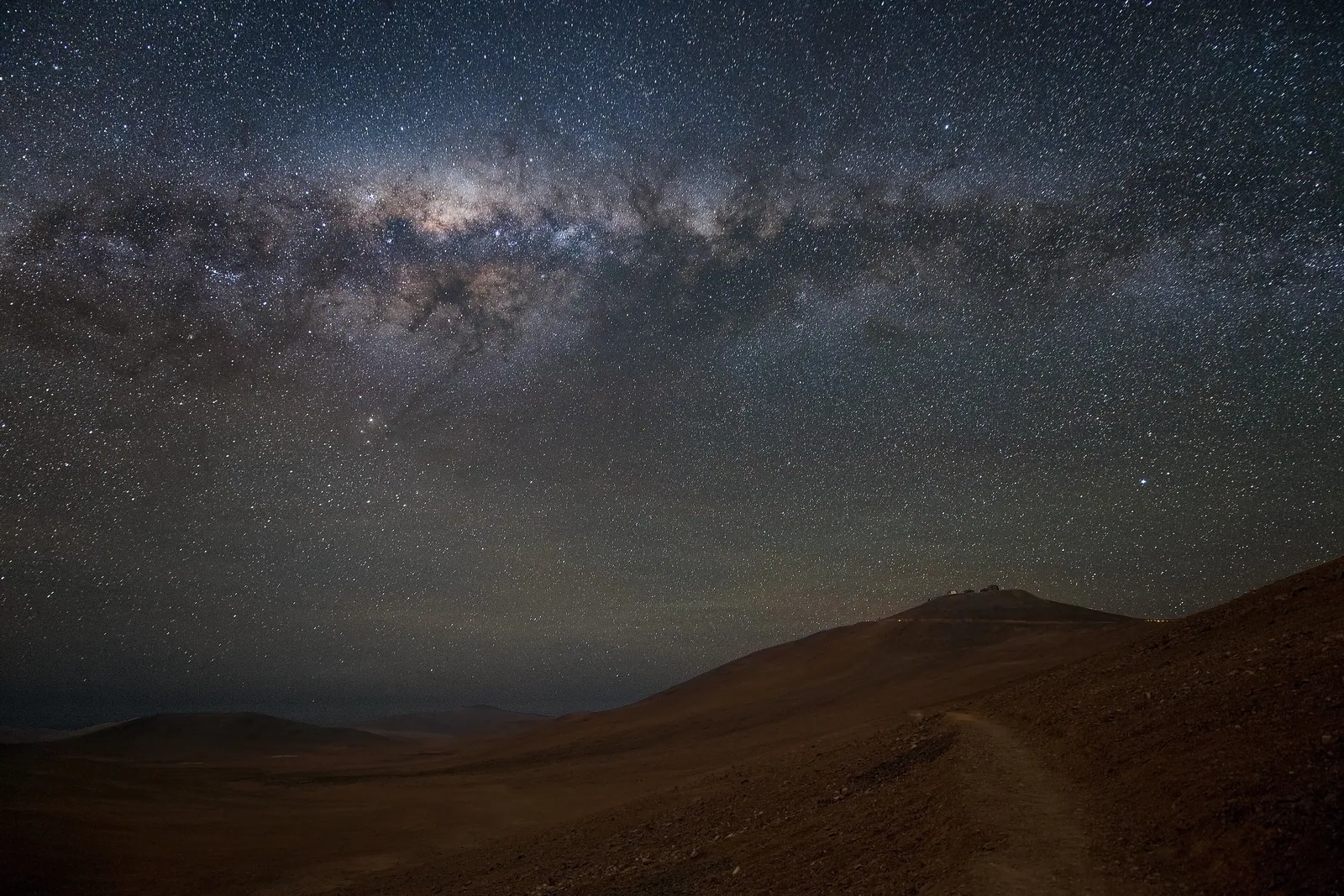
The combination yields more than 300 clear nights a year and skies that, in the best spots, rate Bortle 1 — the darkest classification there is. On a moonless night the Milky Way is bright enough to cast a faint shadow, and the southern sky reveals sights invisible from Europe or North America: the Magellanic Clouds, the Southern Cross, the dense star fields toward the galactic centre.
The great observatories of the desert
The Atacama is home to a concentration of major observatories. ALMA, the Atacama Large Millimeter/submillimeter Array, spreads dozens of giant antennas across the Chajnantor plateau at around 5,000 metres, studying the cold, faint radiation of star and planet formation. ESO's Paranal Observatory, further south, houses the Very Large Telescope, four 8-metre giants that can be combined into a single instrument of extraordinary power.
These are working scientific facilities, not tourist sites, and access is limited — ALMA's plateau is off-limits for health reasons at its extreme altitude, though its lower base centre runs occasional public visits. For the traveller, the observatories are best understood as the desert's credential: the reason to trust that the sky overhead really is among the finest anywhere.
How a traveller actually sees the sky
What a visitor can do, and easily, is join a guided stargazing session near San Pedro de Atacama. These run from astronomy-focused outfits and from the lodges — Explora Atacama, for instance, has its own observatory — and a good one pairs naked-eye sky-reading with views through a telescope. An astronomer walks you through the southern constellations, then turns the instrument on the Moon's craters, Saturn's rings, distant star clusters and nebulae.
Timing matters more than anything. The sky is darkest when the Moon is below the horizon, so the nights around the new Moon are far better for faint objects than those near the full Moon. A serious stargazing evening is worth planning a clear, moonless night around — and worth dressing for, since the desert turns sharply cold once the sun is down.
The southern sky, and what you will see
Travellers from the Northern Hemisphere are often unprepared for how different the southern sky is. The familiar Plough is gone; in its place stand the Southern Cross and the two bright Pointer stars of Centaurus. Most striking of all are the Magellanic Clouds — two faint, detached smudges of light that are in fact whole companion galaxies to our own, visible only from southern latitudes.
The Milky Way itself is the headline. From the Atacama its band is not a faint suggestion but a structured river of light, with dark dust lanes clearly visible against the star clouds, brightest toward the constellation Sagittarius and the centre of our galaxy. An hour spent simply letting your eyes adjust, with no telescope at all, is among the desert's quiet wonders.
The Atacama sky on a grand journey
On Andes to Antarctica and The Pacific Arc, a guided night under the stars is a deliberate part of the Atacama Desert leg — not an optional extra but one of the leg's defining experiences. And on Beyond the Blue, the journey to the planet's extremes, the Atacama is chosen as the very opening chapter precisely because of its skies: the desert is where travellers first learn to read the southern heavens before the journey carries them on.
However it is reached, the principle is the same. The Atacama is one of a small handful of places on Earth where an ordinary traveller, on an ordinary evening, can see the universe roughly as it appeared to every generation before the invention of the streetlight. It is worth setting aside a clear, dark night to do nothing else.
Quick answers
Why is the Atacama Desert so good for stargazing?
The Atacama combines the four things that make a sky excellent: it is extremely dry, so little water vapour blurs the light; it is high, lifting telescopes above much of the atmosphere; it is far from cities, so light pollution is minimal; and its air is unusually steady. The result is more than 300 clear nights a year and some of the darkest skies on Earth — which is why major observatories such as ALMA and ESO's Paranal are based here.
Can tourists visit the observatories like ALMA and Paranal?
Access is limited, as these are working scientific facilities. ALMA's antenna plateau sits near 5,000 metres and is off-limits to visitors on health grounds, though its lower base centre runs occasional public visits, and ESO's Paranal has at times offered weekend tours. Most travellers instead join a guided stargazing session near San Pedro de Atacama, where an astronomer provides telescopes and explains the southern sky.
When is the best night for stargazing in the Atacama?
A clear night with little or no Moon. The sky is darkest when the Moon is below the horizon, so the nights around the new Moon reveal faint objects — the Milky Way, the Magellanic Clouds, distant nebulae — far better than nights near the full Moon. The Atacama has clear skies year-round, so it is the lunar phase, not the season, that matters most. Dress warmly; desert nights turn cold fast.
Let the reading become a route.
When an article sparks something, our planners are the next step. Tell us what you are dreaming of.