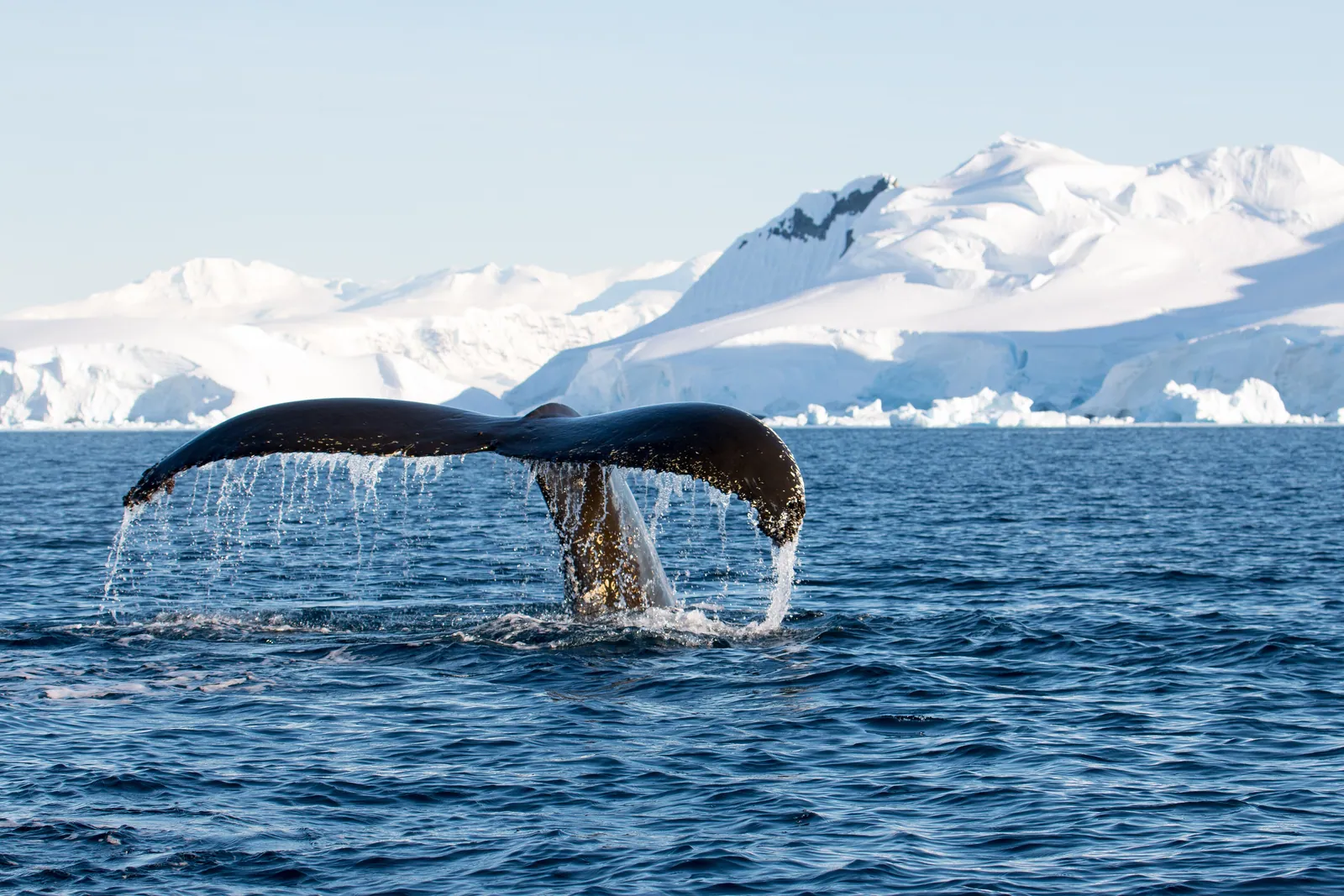
Whales and Where to See Them on the Grand Journeys
The great whales are the largest animals ever to have lived, and several of our journeys cross their waters. Here is which whales to look for, when, and how to read the sea for a distant blow.
A whale surfacing is one of the few wildlife sights that can silence an entire ship. After centuries of industrial hunting that pushed many species to the edge, the great whales are slowly returning to the world's oceans, and a traveller crossing the Southern Ocean or the coasts of the Pacific now has a real and rising chance of meeting them.
Whales follow long seasonal migrations between cold, food-rich feeding grounds and warm, sheltered breeding waters, so where you see them depends entirely on the month. This guide maps the species you can hope to encounter on journeys such as Andes to Antarctica, Beyond the Blue and The Pacific Arc — and how to watch the water so you do not miss them.
Baleen and toothed: the two kinds of whale
Whales divide into two great groups. The baleen whales — humpback, blue, fin, minke, right and others — have no teeth; instead, plates of fibrous baleen sieve vast quantities of tiny krill and small fish from the water. They include the largest animals that have ever existed, the blue whale among them, longer than any dinosaur.
The toothed whales — sperm whales, orcas, belugas and all the dolphins and porpoises — hunt larger prey individually, using echolocation to find fish and squid in dark or deep water. Knowing which group you are watching helps you read its behaviour: a baleen whale lunging through a krill swarm and an orca pod coordinating a hunt are doing very different work.
Whales of the Southern Ocean
The seas around Antarctica are one of the planet's great summer feeding grounds, fuelled by immense swarms of Antarctic krill. From December to March, humpback and minke whales are common along the Antarctic Peninsula, often seen feeding among the ice, and fin and even blue whales range the deeper water offshore.
Orcas patrol these waters too, in distinct ecotypes that specialise in different prey, from seals to fish. The Drake Passage crossing on Andes to Antarctica is itself prime whale water — many travellers see their first blows from the deck before they ever reach the continent.
The southern right whale and the Patagonian coast
The southern right whale is the signature whale of Patagonia's Atlantic shore. Between roughly June and December, mothers bring their calves into the sheltered bays of peninsulas such as Valdés to breed and nurse, coming so close to shore that they can sometimes be watched from a clifftop.
Right whales were named, grimly, because slow-swimming and floating when killed they were the right whale to hunt — and they were nearly wiped out. Their steady recovery in southern waters is a quiet conservation success, and a calf rolling alongside its mother in a calm bay is one of the gentlest wildlife sights a southern journey offers.
Whales of the warm Pacific
Along the Pacific coasts of the Americas, the same humpbacks that feed in polar seas arrive to breed in warmer water. Off Pacific Latin America the southern-hemisphere humpbacks gather to calve and sing during the austral winter, roughly July to October — a season when males produce the long, structured songs the species is famous for.
The Pacific Arc and Beyond the Blue pass through other rich whale waters: sperm whales in deep offshore canyons, blue whales where cold upwellings concentrate krill, and an abundance of dolphins. A calm morning on deck, watching the meeting of warm current and cold, is often when the sea gives up its biggest animals.
How to spot a whale, and how to watch it well
Learn to look for the blow — the misty exhalation a whale makes on surfacing, often visible as a puff on the horizon long before the animal itself. Each species blows differently: a sperm whale's slants forward and to the left, a right whale's rises in a distinctive V. Scan slowly, give your eyes time, and watch for circling seabirds, which often mark feeding whales below.
Responsible whale watching keeps its distance, lets the whale set the pace, and never pursues, surrounds or cuts off an animal. Engines are slowed and idled near whales to reduce noise and the risk of a strike. Sometimes a curious whale will choose to approach a quiet, stationary vessel itself — and a close encounter on the whale's own terms is worth far more than a chase.
Quick answers
What is the best journey for seeing whales?
Andes to Antarctica is outstanding: the Drake Passage and the Antarctic Peninsula offer humpbacks, minkes and orcas in the austral summer, while the Patagonian coast adds southern right whales in winter and spring. The Pacific Arc and Beyond the Blue cross rich Pacific whale waters, especially during the humpback breeding season.
When is whale season in the southern hemisphere?
It depends on what the whales are doing. They feed in polar waters during the austral summer, roughly December to March, so that is the season around Antarctica. They breed in warmer waters during the austral winter, roughly June to October, which is when right whales gather off Patagonia and humpbacks sing off the Pacific coast.
What is the largest whale, and might I see one?
The blue whale, reaching around 30 metres, is the largest animal known ever to have lived. It remains uncommon after a century of whaling, but it does range the deep waters of the Southern Ocean and cold Pacific upwellings. A sighting is a rare privilege rather than an expectation — fin and humpback whales are seen far more often.
Let the reading become a route.
When an article sparks something, our planners are the next step. Tell us what you are dreaming of.