Whales of the Southern Ocean
Few sights on an Antarctic voyage match a whale rising beside the ship. Here is which species gather around the peninsula, why they come, when to see them, and how they are recovering from a darker history.
The Southern Ocean is one of the great whale theatres of the world. Each austral summer, humpback, minke, fin and other whales travel thousands of kilometres to the cold, krill-rich waters around the Antarctic Peninsula to feed, and an expedition voyage places you among them — sometimes close enough to hear the breath of a surfacing whale.
The whales come for a single reason: food. The summer Southern Ocean blooms with Antarctic krill, a small shrimp-like crustacean so abundant it underpins the entire ecosystem. Understanding that krill-driven feast explains which whales you will see, where, and above all when in the season is best to look.
Why whales gather around the peninsula
Antarctic krill swarm in immense numbers in the Southern Ocean, fed by summer plankton blooms and concentrated by currents and the edge of the sea ice. They are the keystone of the food web — the link between microscopic plants and the largest animals on Earth.
Baleen whales exploit this directly, straining krill from great mouthfuls of seawater. Many of these whales feed intensively through the Antarctic summer and then migrate north to warmer waters to breed and calve, fasting for much of that time. The peninsula, in effect, is their summer dining room, which is why a voyage timed to the season can be so rich in whales.
The whales you are most likely to see
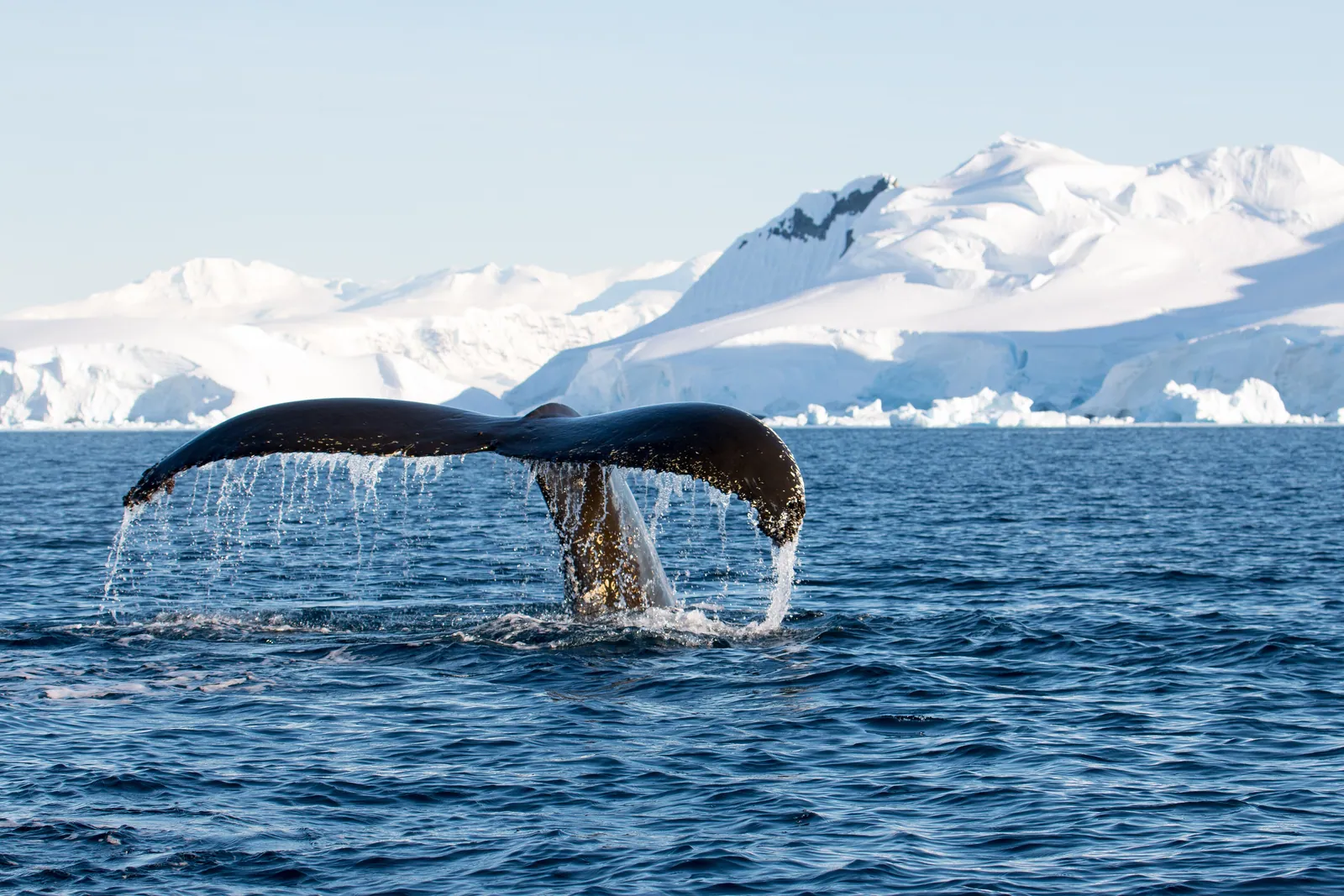
The humpback is the star of most peninsula voyages: acrobatic, curious, often unbothered by a quietly drifting ship or Zodiac, and identifiable by its long flippers, knobbly head and the distinctive underside of its tail flukes, which are as individual as a fingerprint. Humpbacks frequently feed near the surface and sometimes use spectacular bubble-net techniques.
The Antarctic minke whale is smaller, sleeker and common but less showy, often glimpsed slipping along ice edges. The fin whale, second only to the blue whale in size, is increasingly seen gathering in large feeding groups. Killer whales, or orca, also patrol peninsula waters in distinct ecotypes that hunt different prey. The blue whale, the largest animal ever known to have lived, remains rare here after near-extermination, and every sighting is significant.
When in the season to look
Whales can be encountered throughout the Antarctic travel season, but numbers build as the summer progresses. Early in the season the whales are arriving and dispersed; by February and March the krill has had a full summer to flourish and the whales gather to feed in their greatest concentrations.
For this reason late season is widely regarded as the best window for whale watching on the peninsula. Travellers whose chief hope is whales often choose a February or March voyage, while accepting that early-season voyages offer their own rewards in ice and snow.
A history of exploitation, and a recovery
The Southern Ocean's whales carry a heavy history. Twentieth-century industrial whaling killed Southern Hemisphere whales in staggering numbers, driving species such as the blue and fin whale to a tiny fraction of their former abundance. South Georgia and the South Shetlands still bear the rusting relics of shore stations from that era.
Following the commercial whaling moratorium adopted by the International Whaling Commission, some populations have shown encouraging recovery — humpbacks in particular have rebounded strongly in parts of the Southern Hemisphere. The whales a traveller sees today are, in a real sense, a conservation success still in progress, which lends every sighting weight.
Watching whales responsibly
Good whale encounters depend on giving the animals control. IAATO sets specific marine wildlife watching guidelines for ships and Zodiacs: vessels keep their distance, slow down and avoid manoeuvres that could harass or separate whales, and let the animals approach if they choose. A whale that comes to a stationary Zodiac on its own terms has not been chased.
On our Andes to Antarctica journey, whale sightings are among the most memorable moments of the peninsula leg, and they are always conducted within these guidelines. Patience is rewarded: a ship that stops its engines and waits will often find the whales curious enough to come and look back.
Quick answers
What whales can you see in Antarctica?
Voyages to the Antarctic Peninsula commonly encounter humpback whales and Antarctic minke whales, increasingly fin whales, and killer whales (orca). Blue whales and southern right whales are also present in the Southern Ocean but seen far less often. Humpbacks are usually the most visible and approachable, and the highlight of most peninsula voyages.
Why are there so many whales around Antarctica?
The summer Southern Ocean produces immense swarms of Antarctic krill, a small crustacean that is the keystone of the food web. Baleen whales migrate thousands of kilometres to the peninsula to feed on this abundance through the austral summer, then travel north to warmer waters to breed, fasting for much of that journey.
When is the best time to see whales on an Antarctic voyage?
Whales are seen throughout the season, but numbers peak late, in February and March, once the krill has had a full summer to flourish. Late-season voyages along the Antarctic Peninsula are widely considered the best for whale watching, while early-season trips offer their own appeal in fresher snow and ice.
Let the reading become a route.
When an article sparks something, our planners are the next step. Tell us what you are dreaming of.