Xi'an: The Eastern End of the Silk Road
Beyond the Himalaya and the Tian Shan, the great road came down at last to Xi'an — the Tang-dynasty capital the caravans treated as journey's end. A guide to the city where China met the world.
For the merchants of the Silk Road travelling east, the journey ended at Xi'an. Known in its golden age as Chang'an, it was the capital of the Tang dynasty and, for a time, one of the largest and most cosmopolitan cities on Earth — the eastern terminus of the trade route, the place where the long road from the Mediterranean finally arrived.
Today Xi'an is a modern Chinese city of millions, but the Silk Road is still legible in it: in the intact city walls, the Muslim quarter the caravans founded, and the great Tang-era monuments. It is the natural and resonant place for a Silk Road journey to end, and this is a guide to reading it.
Chang'an, capital of the Tang
Under the Tang dynasty, between the 7th and 10th centuries, Chang'an was the eastern anchor of the Silk Road and arguably the most cosmopolitan city in the world. Laid out on a vast grid, it drew merchants, monks, musicians and envoys from across Asia — Persians, Sogdians, Indians, Central Asian Turks — and was, by some estimates, home to a million people.
The trade brought more than goods. Buddhism travelled this road into China; so did music, food, fashion and faiths including Nestorian Christianity and Zoroastrianism. To walk Xi'an with the Silk Road in mind is to understand the route's deepest cargo was never silk but ideas — and Chang'an was where they arrived.
The Terracotta Army
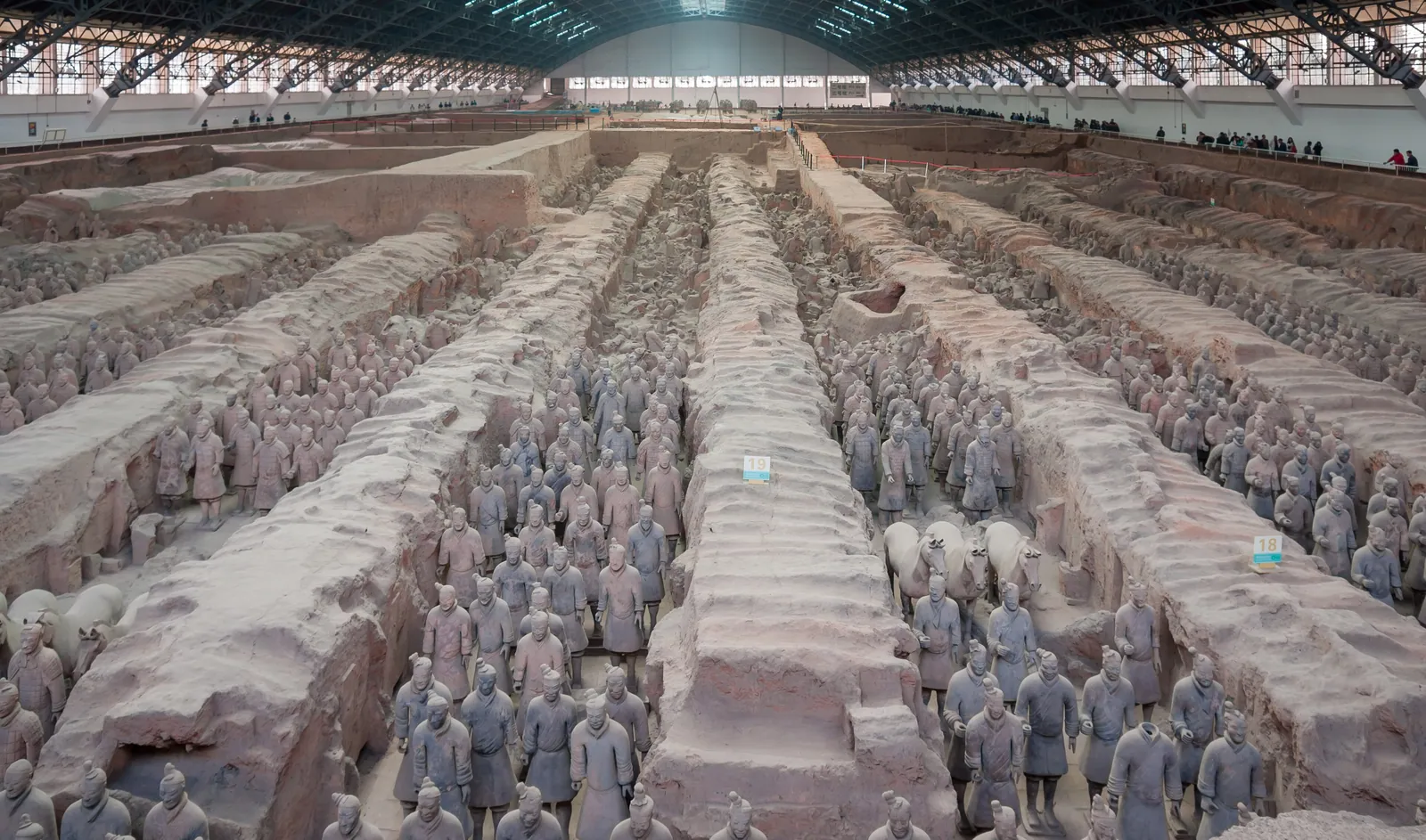
Xi'an's most famous sight predates the Tang by eight centuries. Buried near the city is the mausoleum of Qin Shi Huang, the first emperor to unify China, who died in 210 BCE. Guarding it is the Terracotta Army: thousands of life-sized clay soldiers, each with individual features, arrayed in battle formation and lost to memory until farmers digging a well rediscovered them in 1974.
Standing before the excavated pits is one of the genuine astonishments of travel in Asia. The scale is hard to absorb, and the craftsmanship — every face distinct — stranger still. It is the climactic sight of The Silk Road Reborn, reached overland all the way from the Bosphorus, and a fitting full stop to a journey measured in continents.
The walls and the Muslim quarter
Few cities of Xi'an's size still wear their walls. The Ming-dynasty city wall, raised in the 14th century, survives essentially complete — a broad rectangular circuit some fourteen kilometres around, wide enough on top to walk or cycle, enclosing the old heart of the city. To circle it is to trace the shape of imperial Xi'an.
Within the walls lies the Muslim quarter, home to the Hui community whose presence here traces back to the Silk Road traders themselves. Its lanes are among the liveliest in the city, dense with food stalls, and at their heart stands the Great Mosque — a remarkable building laid out like a Chinese temple yet wholly Islamic in purpose. The quarter is the Silk Road's living legacy in Xi'an.
Tang monuments and the road's faith
The arrival of Buddhism along the Silk Road left Xi'an two great landmarks. The Giant Wild Goose Pagoda, built in the 7th century, was raised to house the scriptures that the monk Xuanzang carried back from his epic pilgrimage to India — texts gathered at the western source of the faith and translated here at its eastern reach.
These monuments make Xi'an more than a museum of objects; they are the endpoints of long journeys of belief. For a traveller completing the Silk Road, they close a circle: the same road that carried silk west carried, eastward, the ideas that reshaped Chinese civilisation — and Xi'an is where you can stand at the receiving end of that exchange.
Ending a journey in Xi'an
The Silk Road Reborn devotes its final stage to Xi'an, and the choice is deliberate. After seventy days, seven countries, three mountain systems and two deserts crossed overland from Istanbul, arriving in the merchants' own destination gives the journey a true ending rather than a mere stop.
It is also a graceful place to come to rest. The pace eases, the high country is behind you, and there is time to absorb the city slowly — the walls at dawn, the Muslim quarter at dusk, the Terracotta Army given a full unhurried day. A grand journey deserves an ending it has earned, and Xi'an, the eastern end of the Silk Road, is exactly that.
Quick answers
Why is Xi'an considered the end of the Silk Road?
Xi'an, known historically as Chang'an, was the capital of the Tang dynasty and the eastern terminus of the Silk Road — the destination the caravans travelling east were heading for. It was where goods, faiths and ideas from across Asia arrived in China. For this reason The Silk Road Reborn ends in Xi'an, reached overland all the way from Istanbul.
What is the Terracotta Army?
The Terracotta Army is a collection of thousands of life-sized clay soldiers buried near Xi'an to guard the tomb of Qin Shi Huang, the first emperor of unified China, who died in 210 BCE. Each figure has individual features. Rediscovered by farmers in 1974, it is Xi'an's most famous sight and the climactic stop of The Silk Road Reborn.
What is the Muslim quarter in Xi'an?
The Muslim quarter is a historic neighbourhood within Xi'an's old walls, home to the Hui community whose roots trace back to Silk Road traders who settled in the city centuries ago. It is known for its lively food lanes and the Great Mosque, a building laid out like a Chinese temple but Islamic in function. It is a living legacy of the trade route.
Let the reading become a route.
When an article sparks something, our planners are the next step. Tell us what you are dreaming of.